
 Search
Assembled Desire: On the Collages of Tom of Finland
8th May 2026, 7:29 pm
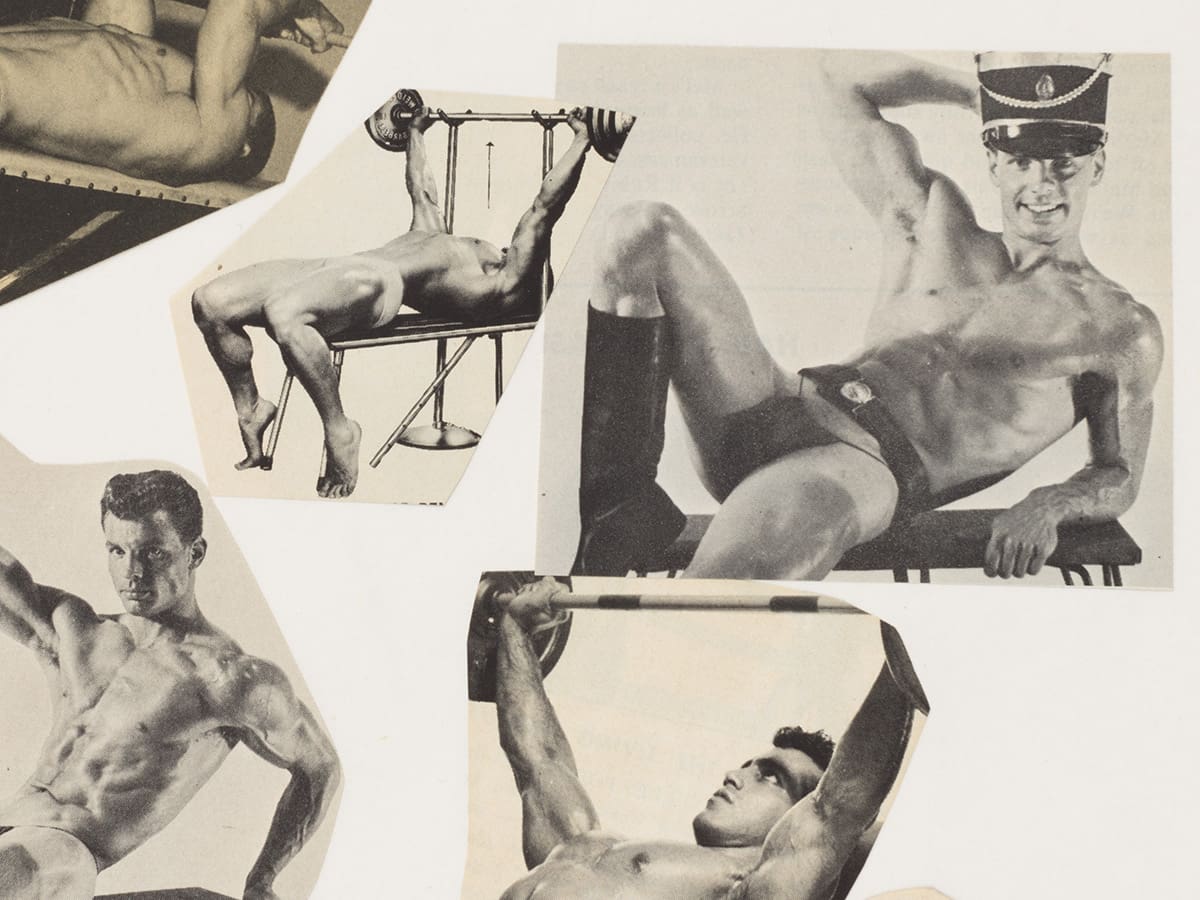
TOM OF FINLAND Untitled (Detail), c. 1966–1990. Photo: Jeff McLane. Courtesy of David Kordansky Gallery and Tom of Finland Foundation
The first collage operates at the scale of myth. Cut-out figures—muscular, idealized, unmistakably drawn from mid-century physique magazines—are stacked in an angular, scaffolded tower; their forms never fully merge but connect through their repeating curves and embodied tension of a vacuumed waist and expanded ribcage. While physique magazines of the period frequently invoked Grecian aesthetics and idealized poses, in the collages these references register less as explicit citations than as ambient influence. Before arriving at his own exaggerated ideal, Tom appears subject to the pull of an already established visual language, one he studies, extracts, and gradually transforms. The eye then moves across these strained anatomies, reconciling similarities that fall short and discontinuities that never quite settle. And yet, the overall effect is one of solidity. The body, though fragmented, becomes monumental and formidable.
This is the paradox at the center of the work: the image gains force not in spite of its seams, but through them.
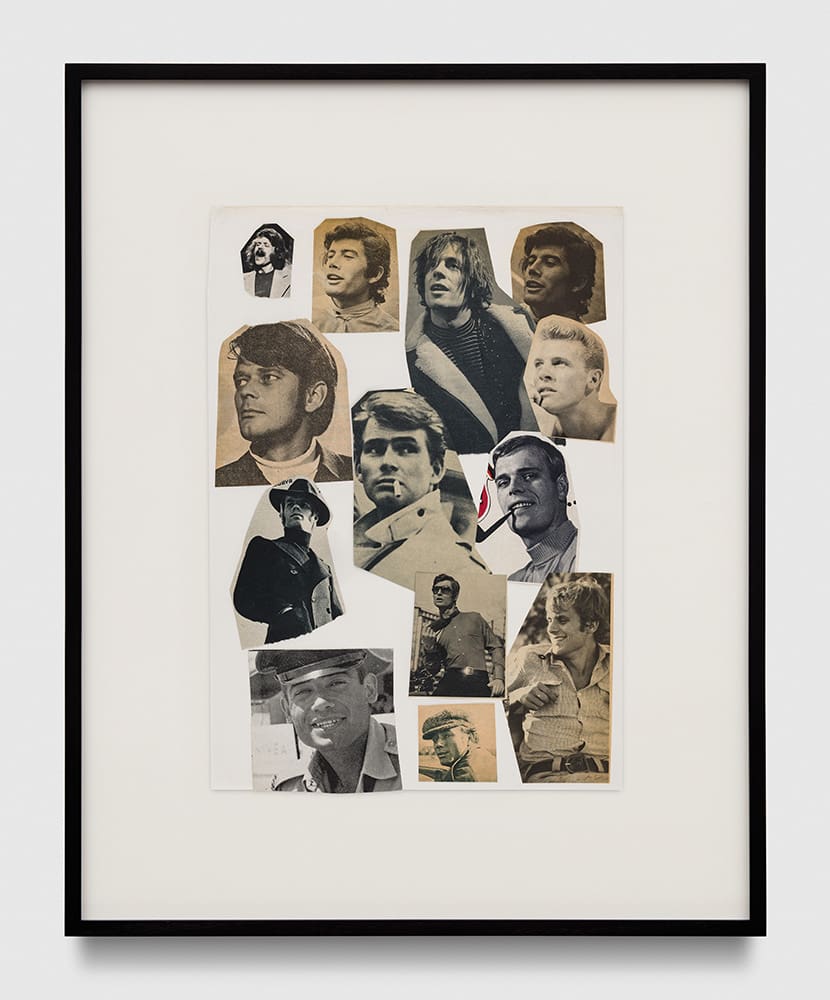
TOM OF FINLAND Untitled, c. 1966–1990. Photo: Jeff McLane. Courtesy of David Kordansky Gallery and Tom of Finland Foundation
These source images were never neutral. Produced within a culture that simultaneously commodified and censored the male body, physique magazines offered a coded visibility ostensibly about fitness, but legible to those who knew how to find what they were looking for. Within José Esteban Muñoz’s framework of disidentification, such images are neither simply accepted nor rejected but actively reworked from within, becoming a strategy of survival for subjects who cannot fully align with or wholly refuse dominant culture. By cutting and reassembling these images, Tom does not simply appropriate them; he intensifies them. He displaces their intended function, draws out their latent charge, and reorganizes it into something more explicit, more controlled. The body here is not discovered, it is engineered, though not without a certain pleasure in the process.
Seen this way, the collage is not exclusively preparatory. It is generative.
It stages the emergence of the iconic Tom of Finland figure not as an invention ex nihilo, but as an accumulation: an image built through careful repetition, variation, and deft selection.
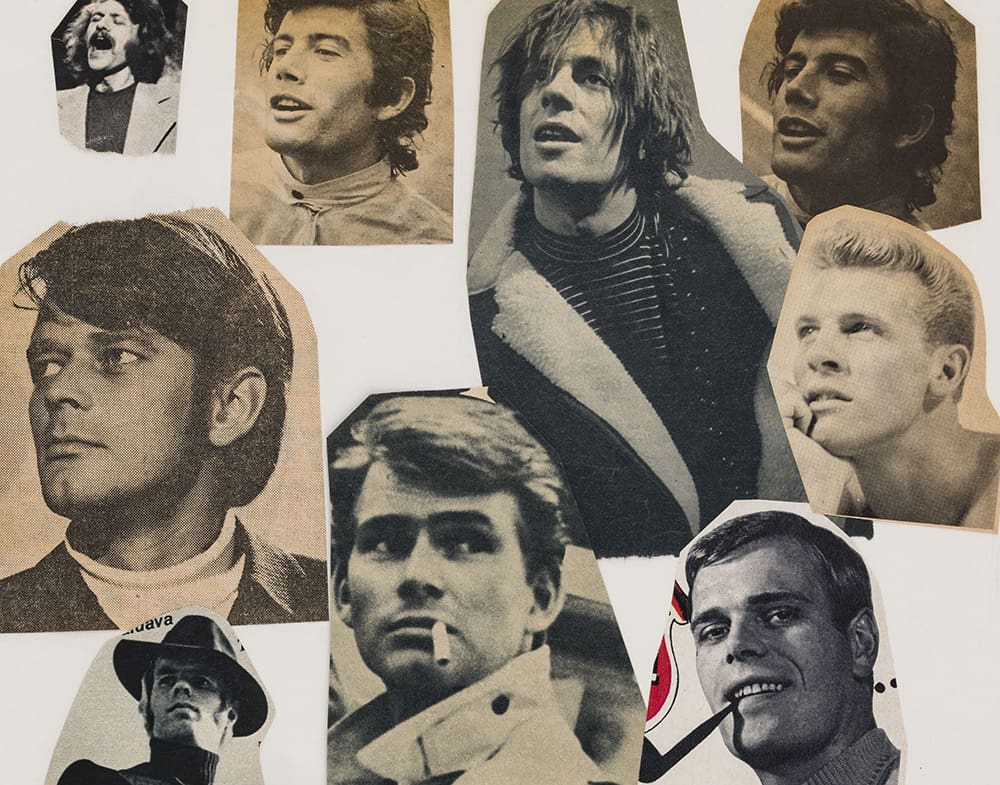
TOM OF FINLAND Untitled (Detail, c. 1966–1990. Photo: Jeff McLane. Courtesy of David Kordansky Gallery and Tom of Finland Foundation
According to Tom of Finland Foundation, these materials formed part of a larger archive through which the artist developed his now-iconic visual language. Cuttings were organized into categories, annotated, sometimes drawn over and reworked. Some photographs he had taken himself. They functioned as working documents, but also as repositories of desire. Seen in this light, the collages are not ancillary to the drawings; they are their infrastructure. They show how the image is made before it appears fully formed, how fantasy is constructed through selection, repetition, and recombination.
READ THE COMPLETE ESSAY BY NICOLO GENTILE
Nicolo Gentile is an artist and educator based in Philadelphia and is an upcoming artist-in-residence at Tom of Finland Foundation.
Tom of Finland (Finnish, b. 1920, d. 1991) is widely regarded as one of the twentieth century’s most influential artists for his groundbreaking representation of the male figure.
Tom’s Stretch, a group exhibition engaging with Tom of Finland’s radical ability to imagine a physique—and a world—that did not yet exist in popular culture, opens at David Kordansky Gallery Los Angeles on 10th July 2026.
Published: 8th May 2026
Tags: David Kordansky Gallery, Nicolo Gentile, Revue Collé, Tom of Finland, Tom of Finland DayCategorised in: Article